Keen observers among you will have noticed that this blog has become a little out-of-date and, despite my best intentions, updated only infrequently.
The simple reason for this is that I’ve just been too busy doing other stuff. I have many things that I’d like to be writing in this pages, but quite frankly not a moment in which to do so.
That’s the bad news!
The good news is that one of the projects I’ve been engaged in is to set up a new news service for people living in or moving to Barcelona. It’s a spin-off of our highly-regarded City Trail Guidebook series.
If you have any interest in Barcelona at all, I would urge you to check out this news service, which is full of helpful tips on what to see and do in the city and its surroundings, living and working in the city, where to eat, fun with kids and much, much more.
Please do consider subscribing to the website, too – it’s totally free, you can cancel at any time, we don’t send any spam and so far the feedback from readers has been pretty good!
I count myself lucky that just before I had to switch my British driving license for a Spanish one – which would have necessitated taking another driving test, conducted in Spanish – the British and Spanish authorities reached an agreement in which one licensed could simply be converted from one to the other.
This is the good part.
What is less good is that it has proven absolutely impossible to obtain an appointment at the DGT, the local traffic police.
I have tried and tried and tried. Endlessly.
Most of the time the website says that no appointments are available. Occasionally it will let me through to a form that I dutifully fill in, before the website reports that, once more, there are no appointments available.
It’s very frustrating.
What is actually going on, as the recent arrest of 69 people show, is that an organised criminal gang have written a piece of software to book up all the appointment slots, and then sell this appointments to the woebegone foreigner.
I’m quite baffled as to why the Spanish authorities don’t put a proper anti-bot system in place. I’m sure that it would be quite easy to do.
As for me, time is running out. I have six months from March 16 to convert my license, otherwise I will have to retake my test here.
I briefly toyed with the idea of writing a Python script to automatically book an appointment – it really doesn’t look too hard, and if criminals can do it I’m sure I can too – but in the end opted for phoning the DGT instead, and hitting buttons in response to their automated system.
I now have an appointment tomorrow morning at 8.45. Although it’s far from clear for what I’ve booked the appointment.
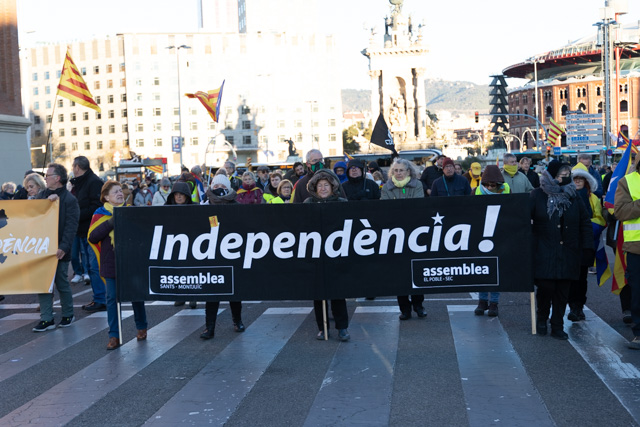
Went along today to experience my first pro-independence protest in Barcelona, which was being held to coincide with the meeting take place between French president Emmanuel Macron and Pedro Sánchez in the city.
As I opined in yesterday’s blog entry, a slightly daft and rather unnecessary move to hold it here – giving the pro-independence movement the perfect platform to make their voice heard.
I turned up about fifteen minutes before the protest was set to start, and was a bit disappointed by the turnout – perhaps the cold had kept the less hardened independentistas away.
But then, after a quick coffee and a delayed breakfast, I returned to the streets to see that the numbers had really built – clearly indicating that the campaign for secession is still very much a going concern.
Only damage that I saw from the protests was a smashed traffic light, though some media report that there were a few scuffles with police after the peaceful protestors had dispersed.
That’s the only observations I have time for today.
I will pontificate about the future of the independence movement in a subsequent blog entry, but I have too many other things going on for now.
Just to say that the turnout, from what I saw, was decent.
French President Emmanuel Macron is due to visit Barcelona this week, to meet with Spanish premier Pedro Sánchez – and the region’s pro-independence movement doesn’t like this.
The meeting is a continuation of an ongoing dialogue between the two leaders to talk about, among other things, a gas pipeline under the Pyrenees (which the French don’t consider terribly important, but which Spain and Portugal say is vital for the ongoing energy security of the continent).
But why is it being held in Barcelona?
The answer from Sánchez’s communications office: that the central purpose of the meeting is to talk about a gas pipeline between Barcelona and Marsalla, so therefore it makes sense to host the meeting in the city where construction will commence.
However the Catalan independence movement see more nefarious intent: it is the start of an election year for Spain and the government very much wants to send a clear signal to the electorate that Barcelona’s independence movement is dead and buried.
And they are not going to let Madrid get away with this. On Thursday morning, just outside where the meeting is taking place, three major groups – the Council of the Republic, the Catalan National Assembly (ANC) and Òmnium Cultural – will be holding a joint protest.
“[We believe that] the Spanish government are having the meeting [here] in order to certify that the Catalan process has died, so we will take to the streets to show that it is very much alive,” Dolors Feliu, president of the ANC, told me last week when I met with her at the ANC offices in the centre of Madrid.
Could the meeting have taken place in another city outside of Catalunya? Absolutely.
Would it have been better for it to have done so? Almost certainly.
To be fair, even since 2017 the central government has been playing games with the Catalan independence movement – and many of these games have been quite effective.
They have launched a “dialogue” with the Catalonian government in an attempt to build bridges with the independence movement and help move things forward from the constitutional crisis that erupted in 2017, when then-president Carles Puigdemont unilaterally (and, incidentally, quite illegally) declared independence for the region.
But as far as I can tell – and clearly is what Dolors Feliu thinks – can tell, this dialogue has made little difference apart from to divide the independence movement cleanly in two, which is quite possibly what Sánchez intended. Whilst Catalonia’s politicians are happy to continue talking with Madrid, Feliu and the ANC wants no part of this.
“It’s true that the Government of Catalonia has tried to make some sort of dialogue, but Pedro Sánchez’s government has shown this dialogue to be fake and not true,” says Feliu. “There view is always: we don’t want an independence movement in Catalonia and we want the dialogue to break the independence movement. I think that people of Catalonia are starting to see this now.”
It feels as if meeting Macron in Barcelona is simply another part of this smoke-and-mirrors game that Sánchez is playing.
And, with his electoral prospects being squeezed by both the right and the left at the moment, he knows that he must play these games well. One of his main rivals on the left – his deputy Yolanda Díaz – was in Barcelona over the weekend, dishing out generous helpings of sympathy upon the independence movement, and suggesting that the grievances in the region are something that really do need to be taken seriously.
Since the right-wing People’s Party (PP), led by Alberto Núñez Feijóo, is likely to seek to smash the Barcelona independence movement at every opportunity, Catalan voters are more likely to cosey over to whatever socialist candidate they feel offers a more credible hotline to Madrid.
Sánchez needs to make his “dialogue” with Catalonia more convincing.
Inviting another head of state here is not the way to do so.
There is a sense that Spain’s prime minister, Pedro Sánchez, is a bit on the back foot these days.
With the Spanish election due next year – no date is set, but it has to be held by December – the rivalry between the ruling Spanish Socialist Socialist Workers’ Party and the right-wing People’s Party (PP) is heating up. Even Spain’s last dictator, Francisco Franco, dead nearly 50 years, has been bizarrely brought into all of this, with the Socialist Workers’ Party moving to ban any group that shows even the slightest bit of support for what Franco did, and the PP saying that this will be overturned should they come into power.
The latest sign that Sánchez is trying to shore up his support ahead of next year’s election is the scrapping of the country’s sedition law that date backs to 1822.
This law leapt into the spotlight five years ago, when it was used to crush any demands for Catalonia independence, handing down fairly stiff sentences to the ringleaders of the movement, including Carles Puigdemont, the former regional president, who remains in exile in Belgium.
Although Sanchez has made no mention of reversing some of the sentences handed down in light of the 2017 unrest, the decision to repeal the archaic sedition law is clearly a further attempt to appease the Catalonian region. He knows that he is likely to need their support in the year ahead – and, along with the support he has given to outlawing pro-Franco organisations, he may well get this.
Ever since Sanchez came to power in June 2018, he has worked to soften Madrid’s stance towards the Catalonia, and to convince the leaders and the people of the uppity region that he is probably the most supportive politician they can get.
The PP is gaining in strength, and is likely to do extremely well on the back of the cost-of-living crisis that is facing the whole of Europe. Energy costs are increasing, inflation is going up, interest rates are likely to push many countries into recession – and it’s going to be the left-wing socialists that will be blamed.
Neither Sanchez’s stance on Franco, not his scrapping of the sedition law, really make much of a difference to the health of the country.
But they are likely to win him friends in certain quarters. And, going into next year, Sanchez will need all the friends he can muster.
I fell into a conversation today – unsurprisingly with two Italians (since I am currently in Naples) – about how the world power is shifting from the West to the East.
We were talking about Ukraine.
There is no doubt that over the past few decades some of the West’s power has been eroded – and China’s rise to prominence has been shockingly fast.
But the problem with such discussions is that they invariably under-estimate the might of the US, whilst building up the Asian tiger into something that it is not… at least, not quite yet.
Having just returned from Hong Kong to Europe, and also spent quite a bit of time writing about US finance, I am in a fairly fortunate position to see how this geopolitical tango is playing out – so here is my take on things.
The power of the US is still formidable. It essentially controls the dollar trade. Okay, granted, unlike the Chinese renminbi, the US greenback is a freely-traded currency, and so the Federal Reserve is not able to control how it is traded and circulated outside of the borders of the United States.
However it does oversee some of the largest banks of in the world, and manages the US dollar clearing system. It can easily shut any non-US bank out of the dollar clearing system (I say non-US bank here, because it would be a bit daft to shut one of its own banks out of the system; it has other ways of dealing with that). Indeed it has done this in the past – in 2016, with BNP Paribas, a French bank, which was shut out of the dollar clearing system for a year due to breaching sanctions with Sudan, Cuba and Iran. Whilst this obviously wasn’t the end of the organisation, it was hugely expensive, and meant that it find other ways in which to clear its US dollars, which would have typically meant using a third party bank that was allowed to clear dollars in New York.
US regulators could have gone even further, and shut off these avenues too. But they didn’t.
So definitely don’t under-estimate the financial weapons that the US has at its disposal. No other country – not even China (yet) – has this kind of fire-power.
So why isn’t it using them to their full capacity in the case of Ukraine – since it could really damage some of these Russian institutions if it did.
Well here are a couple of reasons.
One the US really doesn’t want to go over-board in the US of the financial weapons that it does have available. This could actually play into China’s hands, as the world might suddenly realise that actually Washington does have quite a lot of power, and that perhaps something should be done about this. That something would be to back the renminbi as a rival currency for settling payments. This has started to happen in certain instances – cross-border payments with Russia for oil, for example – but the power of the renminbi still pales into insignificance when set alongside the greenback. (Plus of course the yuan is still subject to currency controls – something that Beijing does need to change if it is ever to rival the greenback in the global payment system).
Two, the US is a democracy full of democratic institutions – and this is likely to hold back the country from extreme actions. And rightly so. Just as with pressing the nuclear button.
Three, the proxy war is also, to some extent, benefitting the US by keeping Russia weak. Here, of course, the US does have to tread carefully, for a weak Russia is also likely to benefit China too, who stands to become King of the Eurasia Region following Moscow’s slow and painful decline. But still, I guess the US sees no harm in grinding its old enemy slowly into the ground – it can deal with the rise of the new one in due course.
So the US does have some mighty fine financial weapons at its disposal. But does it want to use them? Probably not in this war. It will keep them for another time.
Like the vast majority of the politically-minded British electorate I have been following the movements of Boris Johnson for years.
He first leapt to the fore of my conscience – and on to the pages of this blog – in early 2008, when he penned a scathing attack on Sudan for the Telegraph, without once making an effort to understand the situation on the ground. His gripe was over the apparently shoddy treatment of Gillian Gibbons (the British teacher that was accused of blasphemy because she named a teddy bear ‘Mohammed’ in her lesson) and lamenting that we could no longer muster enough testosterone to pull together an armada of ships to go rescue the poor lady (just as a belated aside, Mr J.: even in the hey-day of the British Empire, we never actually did that. Just look at what happened to that poor Charles Gordon chap. We dillied and we dallied, and then they cut his head off. And he was supposed to be one of our most beloved heroes).
Incidentally the story of Gillian Gibbons was completely different to the one that Boris Johnson told within the pages of The Telegraph – and indeed which many uninformed journalists repeated ad nauseum. Her arrest and subsequent detention was actually to do with a co-worker who didn’t like her, and happened to be related to the Minister for Justice. The Sudanese government was thoroughly embarrassed by the whole incident. But just you try running that story in our xenophobic press. You simply can’t.
But I digress.
The point I was trying to make at the time – and is now clearly borne out by recent events – is that Boris has built his entire career on fabrications and half-truths, and has only been able to get away with this for so long because he is quite simply a brilliant wordsmith.
Such literally brilliance combined with such a cavalier disregard for the truth is a highly dangerous concoction. It was why I didn’t – at least at first – support his candidacy for Mayor of London.
But then, four years later, after witnessing the energy and enthusiasm of the man, I changed my tune. I was happy that Boris was elected Mayor, but in no way thought that he should ever lead the country. It is one thing to promote cycling or introduce bendy buses in our capital city. It is quite another to shake hands with Olaf Scholz and tell her we are committed to our European partners without reaching for the punchline.
So, no, Boris Johnson should never have been prime minister – and I think that the events that have transpired over the past six months or so rather support this position. His leadership style made a mockery of British politics. It was at once incompetent, irreverent, divisive, arrogant and poisonous.
Boris Johnson, as he has done for most of his life, used his wit and charm to conceal the reality of what was going on behind the closed doors of Westminster – and indeed to conceal the fact that he really wasn’t suited to the job at all.
Very much like the article he wrote 15 years ago about Gillian Gibbons, of which he knew almost nothing.
I’m about to write a blog post that, for some, might be a little bit controversial.
But J.K.Rowling – esteemed author of the Harry Potter books – cannot really write.
I am a little more halfway through reading the fifth book (Harry Potter and the Order of the Pheonix) to my seven-nearly-eight year old son. And, boy, do the chapters drag!
As far as I can tell my son seems to be enjoying it, although this may of course be simply because he wants to stay up later. It may also help that I often cut out large chunks of the book as I’m reading, with no loss whatsoever to the loss of what is actually going on (which rather suggests that the offending paragraphs didn’t really need to be there in the first place).
Granted, I did actually enjoy the first three books. J.K.Rowling certainly has no shortage of ideas, and her invention of Quidditch and Muggles and Gringotts, as well as the characterisations of Hagrid and Dumbledore, were pure genius.
But the problem is she really cannot write.
She ambles through the chapters, with no sense of pace whatsoever, and throws in needless adjectives all over the place, which rather suggests an over-reliance on a well-thumbed thesaurus.
She cannot let anyone just say anything. They always have to be doing something whilst verbally ejaculating. It’s totally distracting, and makes the book twice as long as it needs be. (Though of course the predictable way in which J.K.Rowling uses such adjectives does have the slight advantage that they can be truncated when the bedtime curfew has been generously exceeded, and the chapter – which is rarely less than 25 pages – needs to be brought to a close).
Here is a case in point, chosen at random:
“Mum’s crying again,” said Fred heavily. “…”
“Without a note,” added George. “…”
“We tried to comfort her,” said Fred, moving around the bed to look at Harry’s portrait. “…”
“Didn’t work,” said George, helping himself to a Chocolate Frog. “…”
“What’s that supposed to be anyway?” asked Fred, squinting at Dobby’s painting. “…”
“It’s Harry!” said George, pointing at the back of the picture. “…”
“Good likeness,” said Fred, grinning.
etc. etc.
It’s a predictably unvarying rhythm that you could set a watch by. There’s nothing wrong, of course, with inserting fresh adjectives and descriptions at those points where they need to be inserted, but the rhythmic monotony with which J.K.Rowling does this shows a lack of literary imagination.
Great imagination in the story, of course, but poor imagination in the writing.
The other problem is that J.K.Rowling appears to have written the books in order to keep up with her audience.
She started off writing a great book for kids, but by the time she reached the fifth book, which we are on now, her core audience presumably was adolescent. I really couldn’t care less about the relationship that Harry has with Cho, and Flavio probably feels the same way; it will be a few years before he has to deal with the complexities of the fairer sex.
It’s a shame because I just can’t get on with J.K.Rowling’s writing, but at the same time she has included some really spectacular ideas in her books.
But then I think back to one of my favourite childhood authors: Terry Pratchett. I much preferred Terry Pratchett’s writing to J.K.Rowling’s, of course, but then he did have this occasionally irritating tendency of drifting down an irrelevant path, making it hard for the reader to keep up with the often quite ingenious narrative he was attempting to craft. This happened to such an extent with his later books that I honestly find them quite hard to read, and to this day I think I have never attempted the last few that he penned.
But then I think back to what may be one of my favourite Terry Pratchett books: Good Omens.
Only it wasn’t just authored by him. It was written along with Neil Gammon, who was already fairly well-known for his graphic novels.
And because of this the book adhered to the narrative that the authors were spinning, and had that literary flare that keeps readers glued to the pages.
So maybe all J.K.Rowling really needs is a decent editor. Or perhaps a co-author that can keep her in check.
Locking away her thesaurus – or allowing her only to use it on Sundays – might be a good first step.
When we first arrived in Hong Kong, a little more than seven years ago, we heard of someone known by a certain fraction of society as “689”.
This person was eminently corrupt, something of a buffoon and of course a Beijing loyalist.
His real name was Leung Chun-Ying (or CY Leung) and at the time he was chief executive of a vibrant, exciting and dynamic Hong Kong.
His somewhat derogatory nickname comes from the number of votes that brought him to power: just 689, in a country of more than seven million.
At the time, the label was ‘689’ was a lighthearted way that freedom-loving Hong Kongers would vent their frustration at the Beijing-leaning establishment and the fact that this new Chinese upstart, Xi Jinping, had put paid to any notion that Hong Kong was really in control of its future.
This was in 2015 and China had reneged on an earlier promise that Hong Kong might be able to reform its electoral system to be more representative.
People aren’t joking any more, though. Things are now serious.
Now we have a new securities law, which forbids any direct criticism of how things are being run in the territory, or of China’s involvement.
Now we have a new lady in charge, Carrie Lam, who professes to have humble roots and yet who seems to go out of her way to run contrary to Hong Kong’s interests.
Now we have a country facing a collapse of the national health system that could so easily have been avoided. “Bodies piling up in hospitals” is the kind of headline that shifts newspapers – but it is also the truth.
I have never seen such a total and complete crushing of a state happen in so short a timespan, and Hong Kongers should unequivocally hold Carrie Lam responsible. She comes primed with a noxious cocktail of incompetence, sycophancy and spinelessness. That is probably why she was awarded the top spot.
The latest Covid-19 fiasco is like nothing I have ever seen, and points to a worrying future for what is one of Asia’s most important financial hubs.
It shows a lack of leadership and a tendency for the elite not to listen to anyone else. This is a page torn straight out of the playbook of China’s Communist Party and is likely to spell the end for the Hong Kong that the British gave back to China in 1997.
People are dying in large numbers in Hong Kong. Two years after Covid-19 burst on to the scene, this is deplorable and could easily have been avoided through better preparation. It was inevitable that the zero Covid policy was never going to work in the territory, and that when Covid-19 eventually burst through the defenses it would be impossible to control.
Instead of ramping up the vaccine rate, and educating citizens (especially the elderly) about the importance of getting vaccinated, they spent large amounts of money in shutting Hong Kong off from the rest of the world.
The result is that vast numbers of elderly are now succumbing to the disease, and it is too late to redress this.
And now more mistakes are being made.
Instead of laying out a plan for easing back on zero Covid, the government is doubling down on the policy and still believing that it will work. Even if the government no longer believe in zero Covid, they should have the decency to explain clearly to the citizens about what the way forwards will look like.
We’re now seeing more than 35,000 cases a day – and risking. Researchers at Hong Kong University predicted this a month ago, but I saw no signs that the ruling elite heeded such warnings. The communication strategy is a shambles.
And now we are facing compulsory testing: a sure-fire way to catch the virus if everyone is gathered in the same place.
Not only that, but the day of testing is determined by your Hong Kong identity number, and not by who you live with, and so me, my wife and son could all be tested on different days. This is nuts.
As if to make matters worse, compulsory testing will not work without a proper and strict lockdown. Everyone knows that – but does the government?
Carrie Lam has repeatedly ruled out a lockdown. Then, a couple of days ago, news started appearing that a lockdown would be put in place (according to ‘sources’).
Of course it has to, if the testing has any chance whatsoever of being effective.
But the government really needs to communicate this better.
I have never seen such an effective crushing of a state, as I said, and Covid-19 is playing into this. Hong Kong is becoming a laughing stock.
This might not matter to Xi. He has other designs on the territory, including shifting the centre of power to Shenzhen.
But it should matter to the Hong Kong people. And Carrie Lam is the one that they should blame.
I have just had to cancel an order that we received from Amazon, for one copy of our City Trail Guide to The Hague, which is still proving extremely popular.
I didn’t really want to but I felt that I was left with no choice. The thing is, you see, that we keep sending books to Amazon, to fulfill orders that we have received, and they keep sending them back with no explanation.
This has been happening on such a regularly basis that it is costing us rather a lot of money – and since Amazon take a whopping 40% share of our earnings (and we have to pay postage!) it is starting to become economically unviable to keep selling through Amazon.
We have already removed our Guidebook to Hong Kong from the Amazon listing, and I now fear that we will have to do the same for our Guidebook to The Hague.
I have complained to Amazon many times, and have asked them to explain.
This is what they said to me in their last message:
I understand your concern regarding PO rejected by the FC.
Unfortunately, refusal reasons are not recorded in any of our systems, so I will not be able to provide you with the specific reason your shipment was refused.
I mean: what? No, seriously: what?!
So the reasons for a return are not even recorded on their systems.
What muppet organisation are we dealing with here?
Please, please, please. If you want to do us a favour, don’t order our guidebooks from Amazon. Order from our website!

 Blake Evans-Pritchard's Weblog